
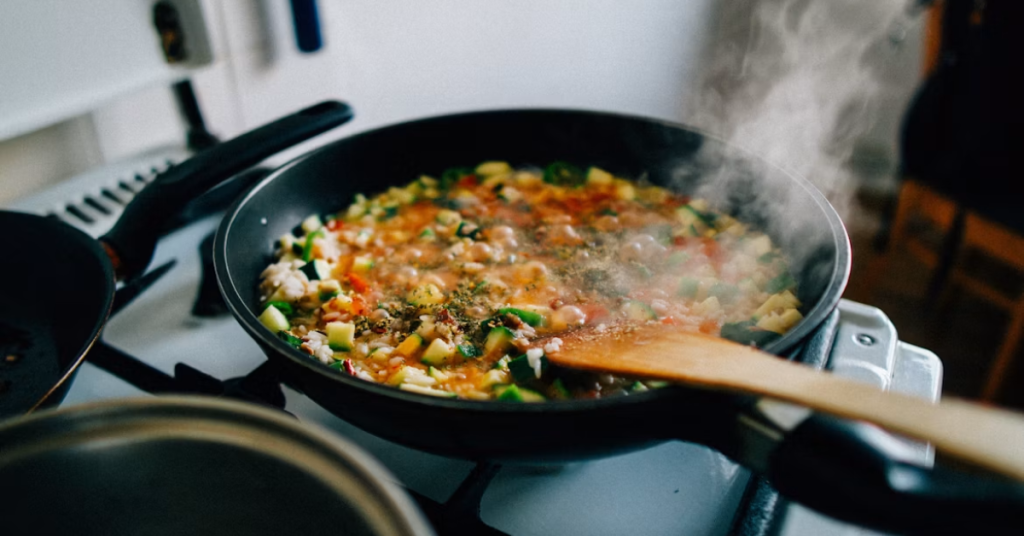
Non-toxic cookware is any pot or pan that won’t leach PFAS, lead or cadmium into your food under normal cooking conditions. That’s the whole definition. No government body certifies a pan as “non-toxic,” so the label works as shorthand for a specific, checkable set of material facts rather than a regulated claim.
Three things drive almost every search on this topic: PFAS, lead and cadmium. PFAS is the umbrella term. It includes PTFE, the compound in Teflon-style coatings, and PFOA, a manufacturing byproduct phased out over a decade ago. PFAS concerns center on nonstick coatings breaking down under high heat. Lead and cadmium concerns center on ceramic glazes and some imported metal cookware, not the plain stainless steel or cast iron most kitchens already own.
The materials that dodge all three risks by default: cast iron, carbon steel, stainless steel, glass and 100% ceramic. None of them carry a coating that can degrade, so there’s nothing to leach in the first place.
This guide breaks down what actually makes cookware toxic, which materials are safe by design, and how to check what’s already sitting in your cabinet.
Disclosure: SmartVentureHub is a member of the Amazon Associates program and other affiliate partnerships. Some links on this page may earn us a small commission if you buy something through them, at no extra cost to you.
Non-Toxic Cookware Materials at a Glance
| Material | PFAS/PTFE-Free | Reactive with Acid | Typical Set Price Range | Where It Trips People Up |
|---|---|---|---|---|
| Cast Iron | Yes | Yes, until seasoned | $50 – $250 | Tomato sauce and wine strip thin seasoning; soap too early undoes months of buildup |
| Carbon Steel | Yes | Yes, until seasoned | $40 – $150 | Usually sold piece by piece, not as a set; same seasoning upkeep as cast iron |
| Stainless Steel | Yes | No | $150 – $800 | Thin single-ply pans develop hot spots; look for tri-ply or 5-ply construction |
| Glass | Yes | No | $20 – $60 | Bakeware only, not stovetop-rated; a cold dish in a hot oven can crack from thermal shock |
| 100% Ceramic | Yes | No | $400 – $1,500 | Priced well above metal cookware; heavier and more breakable if dropped |
| PFAS-Free Ceramic-Coated Nonstick | Yes | No | $60 – $700 | “Ceramic-coated” is a mineral coating over aluminum, not solid ceramic, and it wears out in 1 to 3 years |
What Does Non-Toxic Actually Mean for Cookware?
Non-toxic cookware means the pan doesn’t release PFAS, lead or cadmium into food at normal cooking temperatures. No federal agency defines or certifies the term for cookware specifically. It works instead as a material-science shorthand, not a regulated claim like “organic.”
The FDA does regulate what can touch food. It has authorized specific PFAS substances for use in food contact applications since the 1960s, including nonstick coatings. Current data shows most of those uses don’t create a meaningful exposure risk on their own. The agency has also fielded enough public concern that it maintains a standing Q&A page just on PFAS in food. None of this amounts to a “non-toxic” seal you can look for on a box. The safety case rests on the material itself, not a label.
Which Chemicals Make Cookware Toxic? PFAS, PTFE and PFOA Explained

Three chemical groups account for almost every non-toxic cookware concern. PFAS is a family of thousands of fluorinated compounds. PTFE is the specific PFAS polymer used in Teflon-style coatings. PFOA is a manufacturing chemical once used to produce PTFE, not the coating itself.
PFOA is the part of this story that’s largely settled. Eight major manufacturers agreed to eliminate it from production under the EPA’s PFOA Stewardship Program, targeting a 95% reduction by 2010 and near-elimination by 2015. U.S.-made nonstick cookware sold today isn’t made using PFOA.
PTFE is a different question. It’s still the coating in most traditional nonstick pans, and it’s still classified as a PFAS compound. That said, it behaves very differently from the smaller PFAS molecules found in drinking water or firefighting foam. The EPA continues managing PFAS as a broader chemical class under TSCA, and PFAS exposure is now close to universal. A CDC survey cited by NIEHS found detectable PFAS in the blood of 97% of Americans. That exposure comes from a mix of sources, including food packaging, water and consumer products, not cookware alone.
Is Nonstick (Teflon/PTFE) Cookware Actually Safe?
Modern PTFE nonstick cookware is safe for normal stovetop and oven use. The real safety issue is heat, not the coating itself. PTFE only starts breaking down and releasing fumes once it’s pushed well past normal cooking temperatures, typically because an empty pan got left on high heat.
That temperature threshold is documented. Medical literature on “polymer fume fever,” a short-lived flu-like reaction to inhaled PTFE fumes, puts the fume-release point at roughly 500°F (260°C). Symptoms in humans typically don’t show up until the coating hits about 662°F (350°C). Regular cooking with food and oil in the pan rarely gets anywhere near that. The scenario that actually causes it is a dry, empty pan forgotten on a lit burner for several minutes. That’s also the exact situation that ruins a nonstick coating anyway. Scratches from metal utensils speed up coating failure over time, but a scratched coating degrades in cooking performance well before it becomes a chemical exposure risk.
Does Lead or Cadmium Show Up in Ceramic or Metal Cookware?
Lead and cadmium show up almost exclusively in ceramic glazes, especially imported and vintage pieces, not in the plain metal cookware most kitchens use daily. The FDA sets extractable-lead limits for ceramic ware and separate limits for cadmium, but enforcement depends heavily on imports actually getting tested at the border.
The FDA’s compliance guide caps extractable lead in ceramic mugs and cups at 0.5 mg/L, and flatware at 3.0 mg/L. Cadmium gets its own separate 0.25 mg/L limit. California’s Prop 65 program goes further and sets a daily lead safe-harbor exposure level at just 0.5 micrograms, a much stricter threshold than the federal food-contact rules. For comparison, federal law caps total lead content in children’s products at 100 ppm, a benchmark built for toys and kids’ gear. Cookware itself sat outside that framework for years, which is part of why the regulatory gap existed in the first place.
Washington closed part of that gap in 2026. Its lead-in-cookware law caps lead in aluminum or brass cookware at 90 parts per million starting January 2026. That limit drops to 10 ppm in 2028, the first rule of its kind in the country. It’s a state law, not a federal one, but it signals where enforcement is heading for cookware specifically.
Which Cookware Materials Are Naturally Non-Toxic?
Five materials are non-toxic by default because none of them use a coating that can wear down: cast iron, carbon steel, stainless steel, glass and 100% ceramic.
Cast iron starts naturally nonstick once seasoned, a process where oil bakes onto the metal and hardens into a slick surface. Lodge, the largest U.S. cast iron maker, ships every pan pre-seasoned and publishes its own seasoning guide for building it up further at home. Cast iron reacts with acidic ingredients like tomato sauce or wine until that seasoning layer is established, which is the main early-ownership complaint.
Carbon steel behaves almost identically to cast iron, minus the weight. It needs the same seasoning routine and reacts the same way to acid early on, but it’s usually sold as individual pans rather than full sets.
Stainless steel has no coating and doesn’t react with acid at all, which makes it the default choice for tomato-based sauces or wine reductions. Quality stainless heats evenly instead of scorching in spots because of All-Clad’s bonded construction, where a layer of aluminum sits between stainless steel from the base up the walls. Cheap single-ply pans skip that layer, which is where stainless steel earns its “food sticks unless you nail the heat” reputation.
Glass cookware is chemically inert, but it’s a bakeware category, not a stovetop one. It cracks under thermal shock if a cold dish goes straight into a hot oven or a hot dish hits a cold counter.
100% ceramic cookware, distinct from ceramic-coated nonstick, has no metal core and nothing bonded to a base. It’s the purest material on this list and the most expensive, and it heats and cools more slowly than metal, which takes some adjustment.
If you want a coating for genuine nonstick convenience without PFAS, look for PFAS-free ceramic-coated cookware instead of PTFE. GreenPan’s Thermolon coating is independently tested for PFAS, PTFE, lead and cadmium and rated to withstand roughly 850°F, well above normal stovetop use. Brands like Caraway use similar mineral-based coatings, third-party tested for PFAS and heavy metals. The tradeoff versus PTFE isn’t safety, it’s lifespan. These coatings typically lose their nonstick performance within one to three years of regular use, faster than a PTFE pan would.
How to Check If Cookware You Already Own Is Toxic
Start with the bottom of the pan. Most legitimate cookware stamps its material and country of origin somewhere on the base, and that stamp answers most of the question in five seconds.
For ceramic pieces, especially mugs, bowls and glazed serving dishes rather than actual cookware, look for bright, glossy glazes and check the country of origin. Imported and vintage ceramics are where the FDA’s lead and cadmium limits actually get tested. Older or handmade pieces sold outside those checks are the highest-risk category by far.
For nonstick pans, check the coating itself. A PTFE surface that’s scratched, flaking or visibly worn through to the metal underneath has failed as a cooking surface, even before it becomes a chemical question. Replace it. A ceramic-coated pan that’s lost its slickness and started sticking has hit the same end of life, just from wear rather than scratching.
For metal cookware without a coating, cast iron, carbon steel and stainless steel, there’s genuinely nothing to check. No coating means no degradation risk, which is the whole appeal of these materials in the first place.
Buying Non-Toxic Cookware for Your Situation
The right non-toxic cookware depends more on your kitchen setup than on any single “best” material. A few common starting points:
If you’re building a full first set from scratch and want a mix of cast iron and ceramic-coated pieces without guessing at brands, our guide to the best non-toxic cookware for beginners walks through a complete lineup.
If you’re furnishing a hot plate or a shared kitchen instead of a full range, space and budget matter more than a complete set. Our best non-toxic cookware for college dorm students guide covers compact, lower-cost options built for exactly that.
The same coating question extends past pots and pans. If you’re shopping for an air fryer, the basket faces the same heat and scratch risks as a skillet. Our best non-toxic, PFAS-free air fryers guide applies the same material checks to that category.
It applies to small kitchen appliances too. An ice cream maker’s churning bowl is food-contact cookware in miniature, and our best non-toxic ice cream makers guide runs the same material screen on those machines.
Frequently Asked Questions
Is PFOA still used in nonstick cookware today?
No. U.S. manufacturers voluntarily phased out PFOA in nonstick production under the EPA’s PFOA Stewardship Program, a process completed by 2015. PFOA was a manufacturing chemical used to make PTFE, not the nonstick surface itself, so its removal doesn’t change how a modern PTFE pan behaves on the stove.
What temperature makes Teflon PTFE release toxic fumes?
PTFE starts releasing fumes around 500°F (260°C), well above normal cooking temperatures, with symptoms in humans typically not showing up until the coating reaches roughly 662°F (350°C). This usually happens when an empty nonstick pan is left on high heat for several minutes, not during regular cooking with food and oil in the pan.
Is ceramic-coated cookware actually non-toxic or just marketed that way?
Genuine PFAS-free ceramic coatings, like GreenPan’s Thermolon, are independently tested and free of PTFE, PFOA, lead and cadmium. The real limitation is durability, not safety. The coating wears down faster than PTFE, usually within one to three years of regular use, and its nonstick performance drops off from there.
Is stainless steel cookware safe for cooking acidic foods like tomato sauce?
Yes. Stainless steel has no coating and doesn’t react with acidic ingredients the way unseasoned cast iron or carbon steel can. Look for 18/10 or 18/8 grade stainless with tri-ply or 5-ply construction, since thin single-ply pans can develop hot spots that scorch sauce unevenly.
How do I know if my old cookware contains lead?
Check the country of origin and look for a bright, glossy glaze, especially on imported or vintage ceramic pieces, since lead in glazes is the most common source. Plain metal cookware carries much lower risk. If you’re unsure about a specific piece, a home lead-test swab from a hardware store gives a quick screen. Lab testing is more reliable for a final answer.
Conclusion
The material tells you almost everything you need to know. Cast iron, carbon steel, stainless steel, glass and 100% ceramic don’t have a coating that can fail, so they stay non-toxic for the life of the pan. PFAS-free ceramic coatings are a reasonable choice if you want nonstick convenience. Just plan to replace them every year or two, instead of cooking on a coating that’s already scratched through.
The real lead risk sits in imported and vintage ceramic glazes, not in the metal cookware most kitchens already use every day. Check the bottom stamp, skip the bright glossy vintage finds you can’t trace, and the material does the rest of the work for you.
Related:
