
Choosing the best Sony camera in 2026 can be challenging, thanks to the brand’s extensive lineup of innovative mirrorless cameras designed for every type of photographer and content creator.
From compact APS-C models ideal for beginners and vloggers to flagship full-frame Alpha cameras built for professional photography, filmmaking, sports, and wildlife, Sony continues to set the standard for cutting-edge imaging technology.
Whether you’re upgrading from a smartphone, replacing an older DSLR, or investing in your first professional camera, Sony’s E-mount ecosystem offers exceptional image quality, lightning-fast autofocus, industry-leading video capabilities, and an impressive selection of lenses to suit virtually any creative need.
In this comprehensive buying guide, we’ve rounded up the best Sony cameras in 2026, comparing their key features, real-world performance, pros, cons, and overall value to help you choose the perfect camera for your budget and shooting style.
2026 Sony Camera Comparison Matrix
| Camera Model | Sensor Type and Resolution | Max Video Spec | Continuous Burst | Key Strength | Best For |
| Sony ZV-1F | 20.1MP 1-Inch CMOS | 4K 30p | 16 fps | Ultra-compact body & bright f/2 lens | First camera off smartphone |
| Sony ZV-E10 II | 26MP APS-C CMOS | 4K 60p 10-bit | 11 fps | E-mount versatility & 10-bit video | Entry-level content creators |
| Sony a6700 | 26MP APS-C CMOS | 4K 120p | 11 fps | 5-axis IBIS & AI subject AF | Serious crop-sensor hobbyists |
| Sony a7 IV | 33MP Full-Frame | 4K 60p (Cropped) | 10 fps | Proven hybrid value and dual card slots | Budget full-frame upgrade |
| Sony a7 V | 33MP Partially Stacked | 4K 60p Oversampled | 30 fps | BIONZ XR2 engine and 30fps burst | Best overall / hybrid workhorse |
| Sony a7R VI | 67MP Stacked CMOS | 8K 30p / 4K 60p | 30 fps | 67MP resolution + fast stacked readout | Studio, landscape and high-res action |
1.Sony ZV-1F
Best First Camera Off Smartphone (~$500)
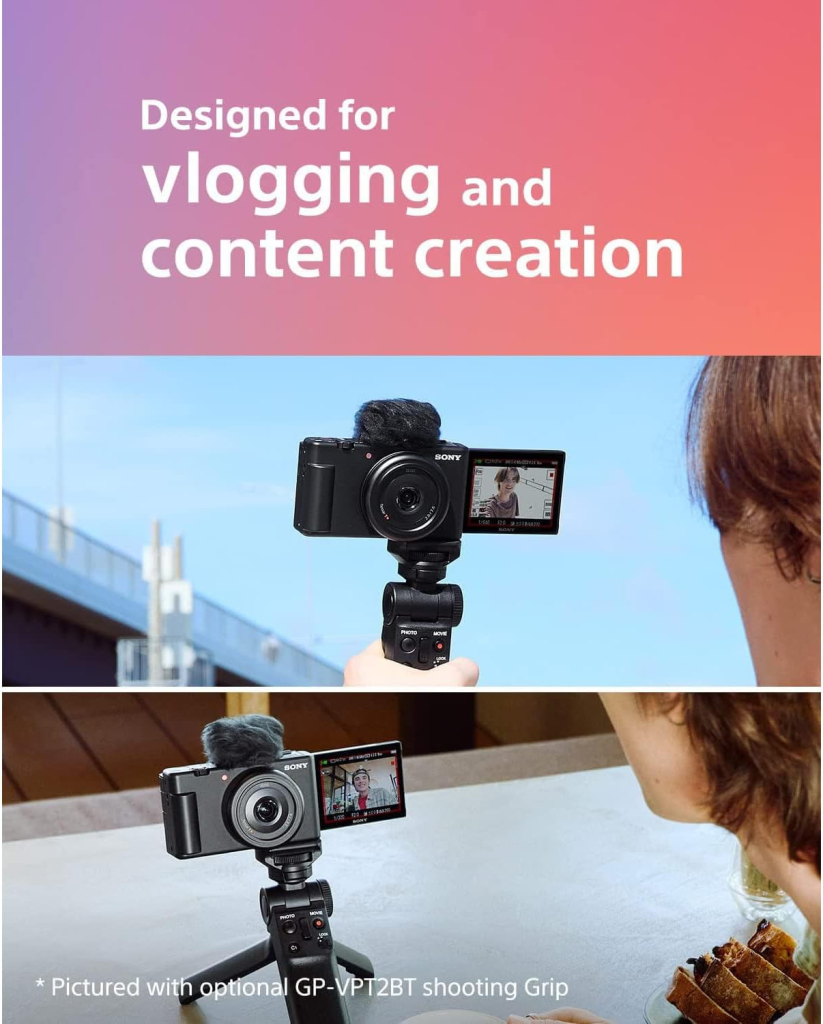
The Sony ZV-1F is an excellent upgrade from a smartphone, featuring a 20.1MP 1-inch sensor and a 20mm f/2 ultra-wide lens for better image quality, natural background blur, and improved low-light performance. Its compact design and 4K video recording make it ideal for vloggers and content creators on the go.
Fast Eye Autofocus and Product Showcase mode help keep subjects sharp during video recording. The lightweight, pocket-sized body also makes it easy to carry for travel, daily vlogging, and social media content creation.

| Feature | Specification Details |
| Sensor | 20.1MP 1-Inch Exmor RS CMOS |
| Video | 4K at 30fps, Full HD (1080p) at 120fps |
| Autofocus | Contrast-detect AF with Real-time Eye AF |
| Display | 3.0-inch fully articulating touchscreen LCD |
Pros
✔ Large 1-inch sensor delivers superior image quality and low-light performance compared to smartphones.
✔ Bright fixed f/2 ultra-wide lens creates natural optical background blur for a professional look.
✔ Built-in directional 3-capsule microphone with included windscreen captures clear, high-quality audio outdoors.
✔ Compact, lightweight design easily fits in a pocket, making it ideal for travel and everyday vlogging.
Cons
❌ Fixed 20mm prime lens offers no optical zoom, limiting framing flexibility for distant subjects.
❌ No RAW image capture support reduces post-processing flexibility for photographers who prefer advanced editing workflows.
❌ Contrast-detection autofocus only is less effective than phase-detection systems when tracking fast-moving subjects.

The Sony ZV-1F is one of the best compact vlogging cameras in 2026, offering a large 1-inch sensor, sharp 4K video, and a lightweight, travel-friendly design.
While its fixed lens and basic autofocus have limitations, it delivers excellent value for beginners, vloggers, and content creators seeking a significant upgrade from a smartphone.
2. Sony ZV-E10 II
Best First Interchangeable-Lens Camera (~$1,000)
The Sony ZV-E10 II is a versatile mirrorless camera featuring a 26MP APS-C sensor and Sony’s extensive E-mount lens system. It captures stunning stills and high-quality 4K 60p 10-bit 4:2:2 video, while the high-capacity NP-FZ100 battery delivers extended shooting time, making it an excellent choice for vloggers and content creators.
Advanced Real-time Autofocus ensures reliable subject tracking for both photos and videos. Its compact, lightweight body makes it easy to carry for travel, YouTube production, livestreaming, and everyday content creation.

| Feature | Specification Details |
| Sensor | 26MP APS-C Exmor R CMOS |
| Video Specs | Video Specs |
| Autofocus | Real-time Phase Detection Eye AF |
| Battery | NP-FZ100 (extended operating time) |
Pros
✔ Compatible with hundreds of Sony, Sigma, and Tamron E-mount lenses for maximum creative flexibility.
✔ Professional 10-bit 4:2:2 video provides greater color depth for advanced color grading.
✔ High-capacity Sony NP-FZ100 battery delivers excellent all-day shooting endurance.
✔ Fast Real-time Autofocus with Eye AF ensures accurate subject tracking for photos and videos.
Cons
❌ No electronic viewfinder (EVF) means you’ll need to rely entirely on the rear LCD screen for composing photos and videos, which can be challenging in bright sunlight.
❌ No in-body image stabilization (IBIS) requires using optically stabilized lenses or a gimbal for the best handheld shooting performance.
❌ Electronic-only shutter can produce noticeable rolling shutter distortion when capturing fast-moving subjects or shooting under certain artificial lighting conditions.

The Sony ZV-E10 II is one of the best entry-level mirrorless cameras in 2026, combining excellent image quality, 4K 60p video, advanced autofocus, and the flexibility of Sony’s E-mount lens system.
Despite lacking an EVF and in-body stabilization, it delivers outstanding value for vloggers, photographers, and content creators seeking a reliable first interchangeable-lens camera.
3.Sony a6100 / a6700
Best Smart-Deal Crop-Sensor Bodies
The Sony Alpha a6700 stands as Sony’s most advanced APS-C mirrorless camera in 2026, delivering flagship-level performance in an exceptionally compact and travel-friendly body. As the successor to the popular a6000 series, it features a 26MP Exmor R CMOS sensor, powerful AI-driven autofocus, 5-axis in-body image stabilization (IBIS), and weather-sealed construction, making it an outstanding choice for photographers, videographers, and content creators alike.
Whether you’re capturing fast-moving wildlife, cinematic 4K videos, or everyday moments, the Sony a6700 combines professional-grade image quality, intelligent subject tracking, and impressive portability, making it one of the best APS-C mirrorless cameras available today.

| Feature | Specification Details |
| Sensor | 24.2MP (a6100) / 26MP (a6700) APS-C |
| Video Specs | Up to 4K 120p 10-bit (a6700) |
| Body Features | Built-in Electronic Viewfinder (EVF) and ergonomic handgrip |
| Stabilization | 5-axis IBIS (a6700 only) |
Pros
✔ Built-in electronic viewfinder (EVF) enables comfortable shooting in bright outdoor conditions.
✔ Dedicated AI subject-recognition processor delivers faster and more accurate autofocus tracking on the Sony a6700.
✔ Strong availability on the new and used market makes the a6100 and a6700 excellent value for enthusiasts.
✔ In-body image stabilization (IBIS) on the a6700 improves handheld photo and video performance.
Cons
❌ Older Sony a6100 models feature a dated menu system and lack weather sealing, making them less refined than the flagship a6700.
❌ APS-C sensor delivers slightly lower low-light performance and shallower dynamic range than Sony’s full-frame Alpha cameras.
❌ Compact rangefinder-style body offers tighter control spacing, which may feel cramped for users with larger hands or those accustomed to larger full-frame cameras.

Whether you choose the budget-friendly Sony a6100 or the feature-packed Sony a6700, both cameras deliver outstanding image quality, fast autofocus, and access to Sony’s extensive E-mount lens ecosystem.
The a6100 is an excellent value for beginners, while the a6700 adds AI-powered autofocus, in-body image stabilization, and advanced video features for serious creators. If you’re looking for one of the best Sony APS-C mirrorless cameras in 2026, either model is a smart investment for photography, vlogging, and content creation.
4.Sony a7 IV
Whether you choose the budget-friendly Sony a6100 or the feature-packed Sony a6700, both cameras deliver outstanding image quality, fast autofocus, and access to Sony’s extensive E-mount lens ecosystem.
The a6100 is an excellent value for beginners, while the a6700 adds AI-powered autofocus, in-body image stabilization, and advanced video features for serious creators. If you’re looking for one of the best Sony APS-C mirrorless cameras in 2026, either model is a smart investment for photography, vlogging, and content creation.

| Feature | Specification Details |
| Sensor | 33MP Full-Frame Exmor R CMOS |
| Video Specs | 4K 60p (1.5x Super 35 crop), 4K 30p oversampled from 7K |
| Card Slots | Dual slots (1x CFexpress Type A / SD, 1x SD UHS-II) |
| Burst Shooting | Up to 10 fps |
Pros
✔ 33MP full-frame sensor provides excellent detail while keeping file sizes manageable.
✔ Dual SD card slots enable instant file backup for greater reliability during professional shoots.
✔ Recent price reductions make it one of the best-value full-frame Sony cameras available.
✔ Excellent dynamic range and low-light performance produce clean, detailed images in challenging lighting conditions.
Cons
❌ 4K 60p video recording applies a 1.5× Super 35 crop, reducing the field of view when filming at higher frame rates.
❌ 10 fps continuous shooting is slower than the burst speeds offered by newer stacked-sensor mirrorless cameras, making it less competitive for demanding action photography.
❌ No dedicated AI processing unit means subject recognition and autofocus tracking are not as advanced as Sony’s latest 2025 and 2026 camera models.

The Sony A7 IV remains one of the best full-frame mirrorless cameras in 2026, offering an ideal balance of image quality, advanced autofocus, and professional video capabilities.
Its 33MP sensor, reliable dual card slots, and excellent low-light performance make it a top choice for photographers, videographers, and hybrid content creators alike. If you’re looking for a versatile camera that delivers exceptional value and long-term performance, the Sony A7 IV is a smart investment.
5.Sony a7 V
Best Do-Everything Camera of 2026 (~$2,899)
The Sony A7 V is a powerful full-frame mirrorless camera built for both photography and professional video production. Featuring a 33MP partially stacked CMOS sensor and the advanced BIONZ XR2 processor, it delivers exceptional image quality, blazing-fast performance, and reliable autofocus.
With 30 fps continuous shooting, advanced AI subject recognition, and uncropped 4K 60p video, the A7 V excels at capturing sports, wildlife, portraits, and cinematic content. Its versatile feature set makes it an outstanding choice for photographers and hybrid creators seeking top-tier performance.

| Feature | Specification Details |
| Sensor | 33MP Full-Frame Partially Stacked CMOS |
| Processing Engine | BIONZ XR2 with dedicated AI coprocessor |
| Burst Rate | Up to 30 fps continuous shooting |
| Video Specs | Full-width uncropped oversampled 4K 60p, 4K 120p (Super 35) |
Pros
✔ 30 fps continuous shooting is ideal for capturing fast-moving sports, wildlife, and action scenes.
✔ Partially stacked CMOS sensor greatly minimizes rolling shutter distortion during electronic shutter shooting.
✔ Advanced AI-powered autofocus accurately recognizes and tracks people, animals, birds, insects, and vehicles.
✔ Outstanding hybrid performance combines high-resolution stills with professional-quality 4K video recording.
Cons
❌ Premium price tag makes it a more expensive option than Sony’s previous non-stacked sensor cameras, which may deter budget-conscious buyers.
❌ 33MP resolution may not provide enough detail for photographers who regularly produce ultra-large prints or require extensive cropping.
❌ CFexpress Type A memory cards are recommended for clearing long 30 fps burst sequences, adding to the overall cost of ownership.

The Sony A7 V sets a new benchmark for hybrid photography and filmmaking, combining a high-resolution 33MP sensor, lightning-fast 30 fps shooting, and industry-leading AI autofocus in one versatile body.
Whether you’re capturing sports, wildlife, portraits, or cinematic video, it delivers professional-grade performance with exceptional speed and reliability. If you’re searching for one of the best Sony full-frame mirrorless cameras in 2026, the A7 V is a future-ready investment for serious creators and professionals alike.
6.Sony a7R VI
Best for Resolution and Speed Without Compromise (~$4,500)
The Sony A7R VI combines exceptional resolution with remarkable speed, making it a powerful choice for demanding photographers. Its 67MP fully stacked full-frame sensor delivers extraordinary detail, while 30 fps continuous shooting ensures it can confidently capture fast-moving subjects.
Advanced autofocus and high-speed performance make it equally suited for landscapes, wildlife, studio work, and commercial photography. With its blend of ultra-high resolution and professional speed, the A7R VI is one of Sony’s most capable mirrorless cameras for creators who refuse to compromise.

| Feature | Specification Details |
| Sensor | 67MP Full-Frame Fully Stacked Exmor RS CMOS |
| Readout Speed | ~5.6x faster readout than the previous generation |
| Burst Shooting | 30 fps at full 67MP resolution |
| Video Specs | 8K 30p oversampled, 4K 60p |
Pros
✔ Massive 67MP full-frame sensor captures extraordinary detail for large prints and extensive cropping.
✔ Fully stacked sensor enables blazing-fast 30 fps continuous shooting at ultra-high resolution.
✔ Pre-capture RAW buffering helps preserve critical moments before the shutter is fully pressed.
✔ Outstanding dynamic range delivers rich colors and exceptional detail in both highlights and shadows.
Cons
❌ Large high-resolution image files require high-capacity memory cards, substantial storage space, and a powerful computer for smooth editing and post-production.
❌ Higher-resolution sensor produces slightly more visible image noise at extremely high ISO settings compared to lower-resolution camera models.
❌ Premium price point makes it a significant investment that may be difficult to justify for hobbyists and casual photographers.

The Sony A7R VI is one of the best high-resolution mirrorless cameras in 2026, delivering exceptional image quality without compromising speed. Its 67MP stacked sensor, advanced AI autofocus, and 30 fps continuous shooting make it ideal for landscape, wildlife, commercial, and studio photography.
If you need unmatched detail, professional performance, and the flexibility to handle virtually any shooting scenario, the Sony A7R VI is a top-tier investment.
How We Test Sony Mirrorless Cameras
Every Sony mirrorless camera featured in this guide is evaluated through a combination of controlled benchmark testing and real-world shooting to ensure accurate, unbiased recommendations.
✔ Autofocus and AI Subject Tracking: We test autofocus in low light, backlit scenes, and fast-action sports, wildlife, and portrait situations to evaluate Eye AF accuracy, subject recognition, and tracking performance.
✔ Image Quality and Sensor Performance: We assess sharpness, dynamic range, color accuracy, shadow recovery, highlight retention, and high-ISO noise using both RAW and JPEG files.
✔ Video Performance: We record extended 4K and 8K video to evaluate video quality, rolling shutter, stabilization, autofocus consistency, and overheating during long recording sessions.
✔ Ergonomics and Handling: We review grip comfort, button layout, electronic viewfinder (EVF), touchscreen responsiveness, menu usability, and overall handling during prolonged use.
✔ Battery Life: We measure real-world battery performance during photography and continuous video recording to determine overall shooting endurance.
How to Choose the Best Sony Camera: 5-Point Buying Guide
✔ Choose the Right Sensor Size: Select a full-frame camera for superior low-light performance, dynamic range, and background blur, or an APS-C model for a lighter kit, lower lens costs, and extra telephoto reach.
✔ Invest in Quality Lenses: A great lens often has a bigger impact on image quality than the camera body. Prioritize high-quality Sony or third-party lenses to maximize your camera’s performance.
✔ Match the Camera to Your Shooting Style: For portraits and landscapes, a standard sensor is ideal. If you shoot sports, wildlife, or fast action, choose a camera with a stacked or global shutter sensor for faster burst speeds and reduced rolling shutter.
✔ Consider Your Video Requirements: Content creators should look for features such as 4K 60p recording, 10-bit 4:2:2 color, reliable autofocus, and image stabilization for professional-quality video production.
✔ Plan for Total Ownership Costs: Remember to budget for lenses, memory cards, extra batteries, storage drives, and editing hardware, especially if you’re buying a high-resolution Sony camera that produces large image and video files.

Frequently Asked Questions (FAQs)
Q: Is the Sony ZV-1F good for photography?
A: Yes. Its 20.1MP 1-inch sensor and f/2 lens produce sharp photos with excellent low-light performance, making it a great upgrade from a smartphone.
Q: Can I use APS-C lenses on a Sony full-frame camera?
A: Yes. Sony full-frame cameras automatically switch to APS-C crop mode, though image resolution is reduced.
Q: Is the Sony A7 V worth upgrading from the A7 IV?
A: Yes. The Sony A7 V adds a partially stacked sensor, AI autofocus, 30 fps burst shooting, and uncropped 4K 60p video for improved hybrid performance.
Q: Which is better, the Sony A9 III or Sony A1 II?
A: The A9 III is ideal for sports and wildlife, while the A1 II is the better all-around choice for professional photography and video.
Q: Are Sigma and Tamron lenses compatible with Sony mirrorless cameras?
A: Yes. Most Sigma, Tamron, and other native E-mount lenses support fast autofocus and work seamlessly with Sony mirrorless cameras.

Conclusion
Sony continues to lead the mirrorless camera market with a lineup that caters to every type of creator, from beginners and vloggers to professional photographers and filmmakers. Whether you’re looking for an affordable APS-C model, a versatile full-frame hybrid, or a flagship camera with cutting-edge autofocus and high-speed performance, there’s a Sony camera to match your needs.
By choosing the right body and pairing it with quality E-mount lenses, you’ll enjoy exceptional image quality, reliable performance, and a system built to grow with your photography or video journey. If you’re searching for the best Sony mirrorless camera in 2026, the models in this guide represent the top options for every budget and shooting style.
Related articles:
