
Modern smartphones and cameras can capture stunning high-definition video, but their built-in microphones often struggle to deliver equally impressive audio. Background noise, wind, and distant voices can quickly reduce the quality of your content.
For vloggers, filmmakers, and content creators, investing in a dedicated microphone is one of the most effective ways to improve production quality. Clear, well-recorded audio makes videos more engaging and professional.
The best microphone for you depends on how you create. Studio microphones are ideal for podcasts, streaming, and voiceovers, while wireless lavalier systems are perfect for interviews, vlogs, and social media content. Camera-mounted shotgun microphones are also excellent for capturing focused, directional audio.
Below, we have selected six of the best microphones for vlogging and filmmaking, covering different recording styles, budgets, and experience levels. Whether you are a beginner or an experienced creator, you will find options designed to help you capture cleaner, clearer audio.
1.Blue Yeti
The Blue Yeti remains one of the most popular USB microphones for podcasters, streamers, voiceover artists, and content creators. Its biggest advantage is versatility, offering four selectable polar patterns that allow you to adapt the microphone to different recording situations.
Its three-capsule design delivers rich, detailed sound, while the plug-and-play USB connection makes setup simple, especially for beginners. You can connect it directly to your computer without needing an external audio interface.
For creators who primarily record at a desk, the Blue Yeti is a reliable and flexible option. Its solid construction, convenient controls, and excellent sound quality make it a strong choice for podcasts, streaming, voiceovers, and other studio-based content.

Specifications
✓ Microphone Type: The Blue Yeti is a USB condenser studio microphone designed to deliver clear and detailed audio for recording, streaming, podcasting, and voiceovers.
✓ Polar Patterns: It offers four selectable polar patterns Cardioid, Omnidirectional, Bidirectional, and Stereo for different recording situations.
✓ Capsule Design: Its three-capsule condenser array helps capture rich, detailed, and high-quality sound.
✓ Frequency Response: The microphone features a 15Hz–22kHz frequency response, allowing it to capture a broad range of audio frequencies.
✓ Connectivity: It uses a USB connection, allowing for a simple plug-and-play setup without requiring an external audio interface.
✓ Onboard Controls: The microphone includes convenient controls for adjusting volume and quickly muting the microphone during recording or streaming.
✓ Recording Applications: The Blue Yeti is well-suited for podcasting, livestreaming, voiceovers, online meetings, music recording, and desktop content creation.
Pros
✓ Four Polar Patterns: The multiple recording modes make the Blue Yeti suitable for solo recording, interviews, group discussions, and various studio applications.
✓ Excellent Sound Quality: It produces clear and detailed audio that is a significant improvement over most built-in computer microphones.
✓ Plug-and-Play Setup: The USB connection makes it easy for beginners to start recording without requiring additional audio equipment.
✓ Durable Metal Construction: Its solid metal build gives the microphone a premium feel and supports long-term use.
✓ Convenient Controls: Volume adjustment and quick mute controls are easily accessible directly on the microphone.
Cons
✗ Thin Base Padding: The pads beneath the desktop stand may sometimes transmit vibrations, desk bumps, or unwanted hum into your recordings.
✗ Not Ideal for Mobile Recording: Its large desktop design makes it less convenient for outdoor vlogging, travel, or handheld filmmaking.
✗ Limited Camera Compatibility: The Blue Yeti is primarily designed for computers and USB recording setups, making it less suitable for direct connection to most cameras.

The Blue Yeti remains a strong choice for creators looking for a versatile and easy-to-use studio microphone. Its four polar patterns, clear sound quality, durable construction, and plug-and-play USB setup make it suitable for podcasting, streaming, voiceovers, online content creation, and other desktop recording applications. The built-in volume and mute controls also add convenience, particularly for beginners and home-based creators.
However, its large desktop design and USB-focused connectivity limit its versatility for mobile filmmaking and direct camera use. If you primarily record at a desk and want a reliable microphone that delivers impressive audio without requiring complicated equipment, the Blue Yeti is an excellent option. For creators who need maximum portability or a microphone designed specifically for cameras, a wireless or shotgun microphone may be a better choice.
2.RODE Wireless GO Gen 3
Best Dual-Channel Wireless System
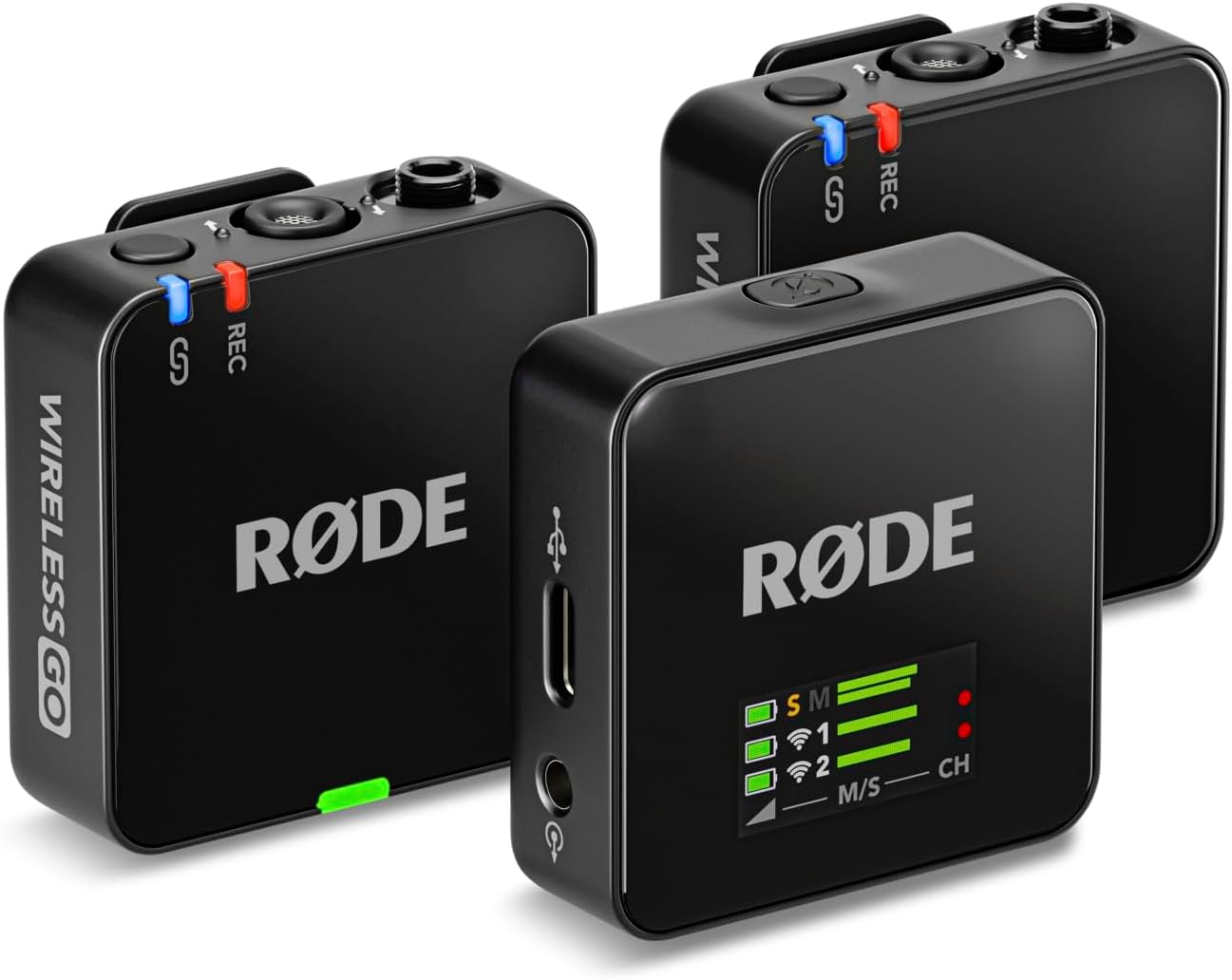
The RODE Wireless GO Gen 3 is an excellent choice for creators who need clear, reliable audio while moving freely during filming. Its wireless design eliminates the need for long cables, making it ideal for vloggers, presenters, interview subjects, and filmmakers.
With two transmitters included, the system can record two people simultaneously, making it especially useful for interviews, podcasts, documentaries, and two-person video content. The system also provides a practical solution for creators who need flexibility during run-and-gun productions.
Its Intelligent Gain Assist feature helps manage audio levels automatically, reducing the risk of clipping and inconsistent volume. Combined with clear wireless transmission and low-latency performance, the Wireless GO Gen 3 is a versatile option for creators who want professional-quality audio without being restricted by cables.

Specifications
✓ Microphone Type: The RØDE Wireless GO Gen 3 is a wireless clip-on microphone system designed for mobile content creation, interviews, vlogging, and filmmaking.
✓ Polar Pattern: Its omnidirectional pickup pattern captures sound from multiple directions, making it suitable for recording voices naturally while subjects move.
✓ Dual-Transmitter System: The system includes two transmitters, allowing creators to record two people simultaneously.
✓ Frequency Response: It offers a 20Hz–20kHz frequency response for capturing a broad range of vocal frequencies.
✓ Battery: The transmitters and receiver feature built-in rechargeable lithium-ion batteries for convenient wireless operation.
✓ Wireless Recording: The system allows subjects to move freely without being restricted by long microphone cables.
✓ Wind Protection: Included wind protection accessories help reduce unwanted wind noise when recording outdoors.
Pros
✓ Two-Person Recording: The two transmitters allow you to record two subjects simultaneously, making the system ideal for interviews and collaborative content.
✓ Intelligent Gain Assist: Automatic level management helps maintain consistent audio levels and reduces the risk of distorted recordings.
✓ Clear Wireless Audio: The system delivers clean and detailed sound that is well-suited to interviews, vlogs, and professional video production.
✓ Excellent Wireless Freedom: Its wireless design allows creators and subjects to move naturally away from the camera during filming.
✓ Low-Latency Transmission: Audio remains closely synchronized with video, helping reduce editing complications during post-production
Cons
✗ Relatively Bulky Transmitters: The units may be more noticeable on clothing than some smaller wireless microphone competitors.
✗ Requires Regular Charging: The rechargeable system needs to be charged regularly to ensure it is ready for recording.
✗ More Expensive Than Wired Options: Budget-conscious creators may find traditional wired lavalier microphones more affordable.

The RODE Wireless GO Gen 3 is a strong choice for creators who prioritize flexibility, clear audio, and reliable wireless performance. Its dual-transmitter design makes it especially useful for two-person interviews, vlogging, documentaries, and social media content, while Intelligent Gain Assist helps maintain consistent recording levels. The low-latency transmission, broad wireless freedom, and included wind protection also make it a practical solution for both indoor and outdoor filming.
Although the transmitters are slightly bulkier than some competing options and the system requires regular charging, its convenience and versatility make it a worthwhile investment for serious content creators. If you frequently record while moving or need to capture audio from two people at once, the RØDE Wireless GO Gen 3 offers a flexible and professional alternative to traditional wired microphones.
3. Hollyland LARK M2S
Best Discreet Wireless Microphone
The Hollyland LARK M2S is designed for creators who want wireless audio without a large, distracting transmitter visible on their clothing. Its compact design makes it particularly appealing for vloggers, interviewers, filmmakers, and presenters who want their videos to maintain a clean and professional appearance.
Despite its small size, the microphone delivers high-quality audio and supports 24-bit/48kHz recording. Its integrated noise reduction also helps reduce unwanted environmental sounds, making it useful for recording in busy locations.
For creators who prioritize both discreet design and strong audio quality, the LARK M2S is an excellent option.

Specifications
✓ Microphone Design: The LARK M2S features an omnidirectional microphone design that captures sound naturally from multiple directions.
✓ Frequency Response: It supports a 20Hz–20kHz frequency response, allowing it to capture a broad range of vocal frequencies.
✓ Audio Quality: The system records high-quality 24-bit/48kHz audio for clear and detailed sound reproduction.
✓ Battery System: It uses rechargeable batteries, making it convenient for regular wireless recording.
✓ Charging Case: The included charging case provides a practical way to recharge and store the microphone system between recording sessions.
Pros
✓ Highly Discreet Design: The small transmitter is less visually distracting than larger wireless microphone systems, making it ideal for professional-looking videos.
✓ High-Quality 24-Bit Audio: It captures detailed and clear sound suitable for professional content creation, interviews, and video production.
✓ Effective Noise Reduction: The built-in noise-cancellation system helps reduce unwanted background noise for cleaner recordings.
✓ Long Wireless Range: Its impressive transmission range gives creators greater freedom to move away from the camera while recording.
✓ Compact Design: The lightweight system is easy to carry in a small camera bag, backpack, or everyday filming kit.
Cons
✗ Potential Signal Dropouts: Wireless performance may occasionally be affected when the subject turns away from the receiver or when obstacles interfere with the signal path.
✗ Requires Regular Charging: The system relies on rechargeable batteries, so it must be charged regularly before recording sessions.
✗ More Expensive Than Wired Microphones: Budget-conscious users may prefer a traditional wired lavalier microphone as a more affordable alternative.

The LARK M2S is a strong choice for creators who want a discreet, portable, and high-quality wireless microphone system. Its compact transmitter, 24-bit/48kHz audio, effective noise reduction, and long wireless range make it well-suited for vlogging, interviews, social media content, and mobile filmmaking. The compact design also makes it easy to carry and use on the go.
However, its wireless nature means users may occasionally experience signal limitations, while the rechargeable battery requires regular charging. It is also more expensive than traditional wired lavalier microphones. Despite these drawbacks, the LARK M2S offers an excellent balance of portability, audio quality, and convenience for creators seeking a professional wireless audio solution.
4.DJI Mic Mini
Best Value Compact Wireless Microphone
The DJI Mic Mini is an excellent choice for creators who want the convenience of wireless audio without the bulk and complexity of a professional production system. Its lightweight design makes it especially suitable for vloggers, smartphone filmmakers, TikTok creators, and YouTubers.
The microphone focuses on simplicity. It is easy to set up, easy to carry, and designed to provide a significant improvement over the built-in microphone on a smartphone or camera.
For mobile creators who want a compact and affordable wireless microphone for everyday content creation, the DJI Mic Mini offers excellent value.
Specifications
✓ Microphone Design: The DJI Mic Mini uses an omnidirectional microphone design that captures sound naturally from multiple directions.
✓ Frequency Response: It offers a 20Hz–20kHz frequency response for capturing a broad range of vocal frequencies with clear and balanced sound.
✓ Battery System: The microphone uses rechargeable batteries, allowing for convenient wireless recording without disposable batteries.
✓ Charging Case: The included charging case provides a convenient way to store, protect, and recharge the microphone system between recording sessions.
✓ Wireless Connectivity: The system is designed for convenient wireless audio recording, giving creators greater freedom of movement during filming.
✓ Portable Design: Its compact format makes it easy to carry and suitable for vlogging, interviews, filmmaking, and other mobile content creation.

Pros
✓ Lightweight and Compact: Its small, lightweight design makes the DJI Mic Mini easy to carry and comfortable to wear during extended recording sessions.
✓ Beginner-Friendly: The system is simple to set up and operate, making it accessible to creators with limited audio-recording experience.
✓ Long-Lasting Battery System: The rechargeable batteries and included charging case provide additional power for longer recording sessions.
✓ Improved Audio Quality: It delivers significantly clearer and more detailed sound than most built-in smartphone microphones.
✓ Excellent Portability: Its compact design makes it particularly well-suited to mobile creators, vloggers, and travel content producers.
✓ Convenient Wireless Recording: The wireless design gives creators greater freedom of movement without the restrictions of long microphone cables.
✗ No Internal Safety Track: The system lacks a backup recording track, which could leave creators with fewer options if the primary audio recording clips or becomes distorted.
✗ No Dedicated Monitor Display: Users have fewer on-device controls for monitoring audio levels and adjusting settings during recording.
✗ Fewer Professional Features: Advanced filmmakers may require a more sophisticated wireless microphone system with additional recording and monitoring capabilities.
✗ Limited Advanced Controls: Creators seeking extensive customization and professional-level audio management may find the system less flexible than higher-end alternatives.
The DJI Mic Mini is a compact and beginner-friendly wireless microphone system that delivers a significant improvement in audio quality over built-in smartphone microphones. Its lightweight design, convenient charging case, long-lasting battery system, and wireless portability make it an excellent choice for vloggers, travel creators, and mobile content producers.
However, its lack of an internal safety track, dedicated monitor display, and advanced professional controls may limit its appeal to experienced filmmakers. For creators who prioritize portability, simplicity, and clear wireless audio, the DJI Mic Mini offers a practical and reliable solution.

5. BOYA BY-M1
Best Budget Wired Lavalier Microphone
The BOYA BY-M1 proves that you do not need to spend a large amount of money to significantly improve your video audio. This affordable wired lavalier microphone is an excellent choice for beginners, students, vloggers, interviewers, and creators working with a limited budget.
Because it uses a wired connection, the microphone does not suffer from wireless signal interference or transmission dropouts. Its long cable also provides plenty of room for movement during presentations and interviews.
For creators looking for an inexpensive first microphone, the BOYA BY-M1 offers impressive value.

Specifications
✓ Microphone Type: The BOYA BY-M1 is an omnidirectional condenser lavalier microphone designed for clear voice recording.
✓ Polar Pattern: Its omnidirectional design captures sound from multiple directions, allowing users to record naturally without precise microphone positioning.
✓ Frequency Response: It offers a 65Hz–18kHz frequency response for capturing clear and balanced vocal audio.
✓ Power Source: The microphone uses an LR44 battery when required for operation.
✓ Cable Length: Its 6-meter cable provides considerable freedom of movement during recording.
✓ Included Accessories: The microphone comes with a foam windscreen to help reduce unwanted wind noise during recording.
✓ Best For: The BOYA BY-M1 is well-suited for vlogging, interviews, presentations, online videos, and smartphone or camera recording.
Pros
✓ Very Affordable: The BOYA BY-M1 is one of the most accessible microphone upgrades for beginners and budget-conscious content creators.
✓ Clean Audio: It can produce clear voice recordings with relatively low background hiss, making it a noticeable improvement over built-in microphones.
✓ Long Cable: The 6-meter cable provides plenty of length, allowing subjects to move freely while recording.
✓ Reliable Wired Connection: Its wired connection avoids wireless interference, pairing issues, and signal dropouts during recording.
✓ Excellent Value: The microphone offers impressive audio performance and useful features considering its affordable price.
✓ Easy to Use: Its simple design makes it easy for beginners to set up and start recording without complicated audio equipment.
Cons
✗ Plastic Construction: The BOYA BY-M1 has a lightweight plastic build that may require more careful handling than premium microphones with stronger construction.
✗ Cable Management Can Be Difficult: The long 6-meter cable provides freedom of movement but can become tangled or inconvenient during filming.
✗ No Built-In Attenuator: High output levels may potentially cause distortion when the microphone is used with certain recording equipment.
✗ Larger Capsule Design: Its capsule is less discreet than those found on many modern miniature wireless microphones, making it more noticeable when clipped to clothing.

The BOYA BY-M1 remains an excellent choice for beginners and budget-conscious creators looking for a simple way to improve their audio quality. Its affordable price, clear sound, long 6-meter cable, and reliable wired connection make it well-suited for vlogging, interviews, presentations, and basic video production.
However, its plastic construction, long cable, and lack of advanced features mean it cannot match the convenience or premium feel of more expensive wireless microphones. Still, for creators who prioritize affordability and dependable performance, the BOYA BY-M1 offers excellent value and remains one of the best entry-level lavalier microphones available.
6.DJI Mic 3
Best Professional Wireless Microphone Kit
The DJI Mic 3 is designed for professional filmmakers, production teams, interviewers, and serious content creators who require advanced recording features and greater protection against audio loss.
Its built-in storage provides an important backup option, allowing audio to be recorded directly on the transmitter. This can be particularly valuable during important interviews, events, and productions where repeating a recording is impossible.
With features such as 32-bit float recording, adaptive gain control, multi-camera support, and timecode capabilities, the DJI Mic 3 is built for more demanding workflows.

Specifications
✓ Microphone Design: The DJI Mic 3 features omnidirectional microphones that capture sound naturally from multiple directions.
✓ Frequency Response: It supports a 20Hz–20kHz frequency response for clear and detailed vocal recording.
✓ Built-In Storage: The system includes built-in storage, allowing users to record audio directly without always relying on a connected device.
✓ Battery System: It uses rechargeable batteries for convenient wireless recording and repeated use.
✓ Charging Case: The included charging case provides a convenient way to store, protect, and recharge the microphone system.
✓ Advanced Recording: The DJI Mic 3 offers advanced recording capabilities designed to provide greater flexibility for professional content creation.
Pros
✓ 32GB Internal Storage: Built-in storage allows backup recordings to be captured directly on the transmitter, providing additional protection against wireless connection problems.
✓ 32-Bit Float Recording: This recording capability offers greater flexibility when dealing with sudden changes in audio levels and helps preserve more usable audio detail.
✓ Multi-Camera Support: The system is suitable for complex professional productions that use multiple cameras and require coordinated audio recording.
✓ Timecode Capabilities: Timecode support makes it easier to synchronize audio and video across multiple cameras during post-production.
✓ Adaptive Gain Control: The system automatically helps manage audio levels, reducing the risk of clipping and inconsistent sound.
Cons
✗ Overkill for Casual Vloggers: Many everyday creators may not need the DJI Mic 3’s advanced professional features for simple vlogs and basic content creation.
✗ Higher Cost: Its professional recording and workflow capabilities make it more expensive than many beginner-friendly wireless microphone systems.
✗ More Complex Than Entry-Level Options: Users may need additional time to learn, configure, and take full advantage of its advanced functions.

The DJI Mic 3 is a powerful wireless microphone system built for creators who demand advanced audio performance and professional workflow features. With 32GB internal storage, 32-bit float recording, adaptive gain control, timecode support, and multi-camera synchronization, it offers the flexibility and reliability needed for filmmaking, complex productions, and high-end content creation.
However, its advanced capabilities may be unnecessary for casual vloggers and beginners, while the higher price and more complex controls can require a learning curve. For professional filmmakers and serious content creators, the DJI Mic 3 is a worthwhile investment, but users seeking simple, affordable wireless audio may be better served by a more basic microphone system.
Frequently Asked Questions
1. What is the best microphone for vlogging and filmmaking?
The best microphone depends on your content creation style. The RØDE Wireless GO Gen 3 is an excellent all-round wireless option for interviews and vlogging, while the DJI Mic Mini is a strong choice for beginners and mobile creators. For studio recording, podcasting, and streaming, the Blue Yeti is one of the best options.
2. Is a wireless microphone better than a wired lavalier microphone?
A wireless microphone offers greater freedom of movement and is ideal for vlogging, interviews, and walk-and-talk videos. A wired lavalier microphone, such as the BOYA BY-M1, is usually cheaper and does not experience wireless signal interference. The best option depends on whether you prioritize mobility or affordability and reliability.
3. What is the best microphone for smartphone vlogging?
The DJI Mic Mini and Hollyland LARK A1 are excellent options for smartphone vloggers. They are compact, easy to use, and provide much better audio quality than most built-in smartphone microphones. Creators who want more advanced features can consider the DJI Mic 3 or Shure MoveMic 88+.
4. Are shotgun microphones good for filmmaking?
Yes. Shotgun microphones are excellent for filmmaking because their directional pickup patterns focus on sound coming from in front of the microphone while helping reduce unwanted sound from the sides. The RØDE VideoMic GO II is a strong choice for camera-mounted filmmaking and vlogging.
5. What is the best budget microphone for beginners?
The BOYA BY-M1 is one of the best budget microphones for beginners. It is affordable, easy to use, and can deliver surprisingly clear voice recordings. If you prefer wireless recording, the Hollyland LARK A1 is a good entry-level option.
6. Is the Blue Yeti good for YouTube videos?
Yes. The Blue Yeti is an excellent microphone for YouTube videos, podcasts, livestreaming, voiceovers, and other desk-based content. Its multiple polar patterns and plug-and-play USB connection make it particularly useful for creators who record indoors.
7. Do wireless microphones need batteries?
Yes. Most wireless microphones use rechargeable batteries in their transmitters and receivers. Many models, including the DJI Mic Mini and Hollyland LARK systems, include charging cases that make it easier to recharge the microphones between recording sessions.
8. What microphone is best for recording interviews?
Wireless lavalier microphones are generally the best choice for interviews because they keep the microphone close to the speaker’s mouth while allowing the subject to move naturally. The RØDE Wireless GO Gen 3 is particularly suitable for two-person interviews because it supports two wireless transmitters.
9. Is the DJI Mic 3 worth buying for casual vloggers?
The DJI Mic 3 can be an excellent microphone, but its advanced features may be more than casual vloggers need. Professional creators can benefit from features such as internal storage, advanced audio recording, adaptive gain control, and multi-camera capabilities. Casual users may find better value in the DJI Mic Mini.
10. How can I improve the audio quality of my vlogs?
The easiest way to improve vlog audio is to use a dedicated microphone instead of relying on your camera or smartphone’s built-in microphone. Choose a wireless lavalier microphone for talking-head and walk-and-talk content, a shotgun microphone for camera-mounted filming, or a studio microphone for stationary recording. You should also reduce background noise, protect the microphone from wind, and monitor your audio levels while recording.

Conclusion
Choosing the best microphone for vlogging and filmmaking ultimately depends on your content style, recording environment, and budget. The right microphone can dramatically improve the quality of your videos by delivering clearer, more natural, and more professional audio than your camera or smartphone’s built-in microphone. Whether you are recording podcasts at a desk, filming interviews, creating walk-and-talk vlogs, or producing cinematic video content, there is a microphone designed to match your specific needs.
For mobile creators and vloggers, wireless options such as the RODE Wireless GO Gen 3, Hollyland LARK M2S, DJI Mic Mini, and Hollyland LARK A1 provide excellent freedom of movement. The BOYA BY-M1 remains an excellent choice for creators on a tight budget, while the Blue Yeti is ideal for studio-based recording, streaming, podcasting, and voiceovers. Filmmakers who prefer camera-mounted audio can benefit from the directional RØDE VideoMic GO II, while professional production teams may appreciate the advanced recording capabilities of the DJI Mic 3.
Ultimately, upgrading your microphone is one of the smartest investments you can make in your content creation setup. Viewers may be attracted to sharp visuals, but poor audio can quickly make them stop watching. By choosing a microphone that fits your workflow and recording style, you can create clearer, more engaging, and more professional content while giving your audience a better viewing experience.